
The Seven-Lever Metabolic Stack - What to Do When Keto Is Not the Answer
Part 1B of the 'Doable Cocktail' series. The four-question decision logic, the seven-lever metabolic stack, and why coordinated cocktails outperform any single dietary intervention.

Part 1A of this series worked through the disease-by-disease evidence for when ketogenic diet is and is not the right tool. The conclusion was that strict KD genuinely earns its place in a narrow set of cancers - glioma, GBM, BRAF V600+ melanoma, frank insulin resistance - and that for most others, a running metabolic stack changes the calculus substantially by covering the mechanistic ground that diet alone was intended to cover.
This piece answers the natural follow-on question: if not strict keto, then what? What is the decision logic, and what does the alternative actually look like in practice?
The four-question decision logic
This is the simplified version of the logic I now use when designing a dietary backbone for a cancer patient. It is not a substitute for clinician judgement, but it is the scaffolding under it. The full three-category framework -- glycolysis-addicted, ketone-utilising, and lipogenesis-dependent - is summarised in a table at the end of Part 1A.
Question 1: What is the primary metabolic driver of this cancer?
Glycolysis-addicted (glioma, GBM, BRAF V600+ melanoma) → strict ketogenic diet.
IGF-1/insulin/mTOR driven (ER+ breast cancer, HR+/HER2-) → intermittent fasting backbone with periodic FMD cycles.
Fatty-acid-oxidation dependent (FLT3+ AML, some T-cell ALL) → upstream FAO blockade via pitavastatin, danshen, and mildronate. KD as monotherapy is contraindicated in AML. The full AML and PDAC ketone-utiliser biology is in Part 3 of this series coming next week.
Mixed or cancer-stem-cell-rich (TNBC, post-treatment residual disease) → IF backbone with doxycycline pulses targeting the OXPHOS-dependent CSC compartment.
Question 2: Is fasting insulin above 15 microIU/mL or HOMA-IR above 2.5?
Yes → KD induction phase of four to eight weeks to break insulin resistance, then transition to IF maintenance.
No → start with IF directly.
Question 3: Are there established liver metastases on fulvestrant?
Yes → KD is mechanistically justified even in ER+ disease, via the OXCT1 axis, though the stack caveat applies. See Part 1A.
No → IF is sufficient.
Question 4: Can the patient genuinely sustain this for two or more years?
This is the most important question and the one most often skipped. Adherence to ketogenic diet at twelve months in ambulatory cancer patients sits around 30-50%. Adherence to a 14-16 hour nightly fast at twelve months sits at 70-85%.
If the protocol is meant to outlast the cancer, adherence matters more than mechanism.
The seven-lever metabolic stack
Here is the reframe that has changed how I write protocols. A diet is one lever. A protocol is a cocktail of levers, each pulling on a different metabolic vulnerability. For most patients, no single lever - not even the right one - does the whole job.
The stack I am increasingly recommending looks like this. The agents on each lever differ by cancer type but the architecture is the same.
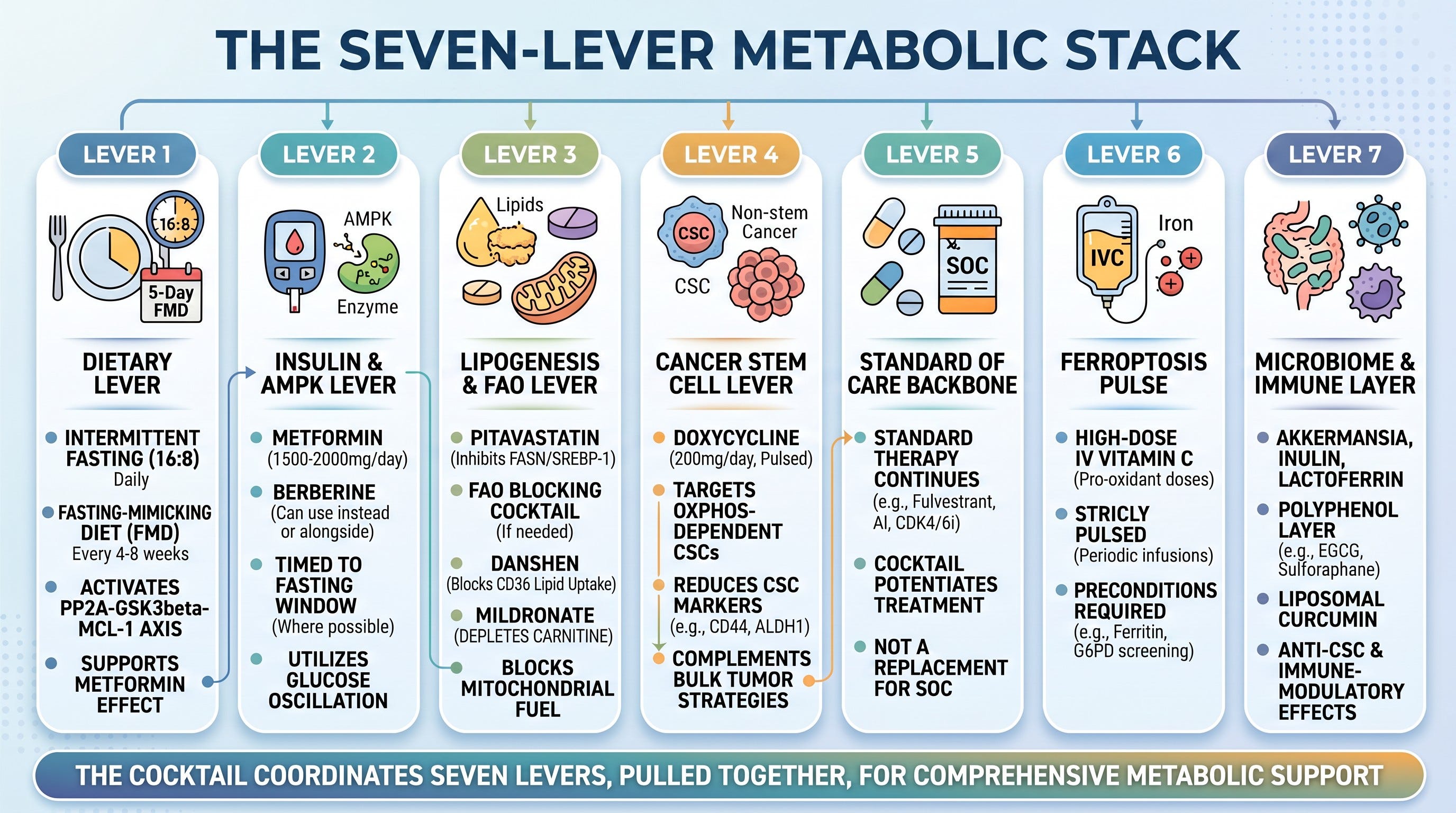
Lever 1: Dietary lever. Intermittent fasting 16:8 daily as the backbone, with a five-day fasting-mimicking diet cycle every four to eight weeks. This is the Caffa/Longo design, tested clinically in the 2020 Nature trial and now being extended in the FMD + CDK4/6i combination (Brandhorst/Longo 2025). The fasting window is not just caloric restriction -- it activates the PP2A-GSK3beta-MCL-1 axis that makes metformin work at its best, per Cazzoli’s 2019 Cancer Cell mechanism.
Lever 2: Insulin and AMPK lever. Metformin 1500-2000mg per day, timed where possible to the fasting window to engage the Cazzoli axis. Berberine covers the same AMPK pathway through a partially overlapping mechanism and can be used alongside or instead of metformin depending on tolerability and drug interactions. The glucose oscillation between the fasting and fed state - not ketosis per se - is what activates this axis. This is a key distinction from the strict-KD approach.
Lever 3: Lipogenesis and FAO lever. Pitavastatin in preference to atorvastatin. Pitavastatin avoids CYP3A4 metabolism, hits FASN and SREBP-1 more effectively, and is more useful in patients on CDK4/6 inhibitors or other CYP3A4 substrates. Pravastatin - a totally different statin - is excluded - it is hydrophilic, with poor tumour penetration.
Where FAO dependency is established or suspected, pitavastatin anchors a three-layer upstream FAO block. Danshen (tanshinone IIA, standardised liposomal preparation from MCS Formulations - use code Jane5 for a discount) inhibits CD36, the fatty acid transporter on tumour cell membranes, blocking circulating lipid uptake independently of what the cancer synthesises. Mildronate (meldonium) blocks BBOX1, the final enzyme in L-carnitine biosynthesis, depleting intracellular carnitine and closing the acylcarnitine shuttle into the mitochondria. No carnitine, no CPT1/CPT2-mediated beta-oxidation, regardless of how much lipid is present upstream.
The reason for my triple upstream approach over direct CPT1 inhibitors is hepatotoxicity. Downstream FAO blockers have a poor safety record outside tightly controlled conditions. My upstream approach, working through FASN, CD36, and BBOX1 in sequence, achieves FAO suppression through three lower-burden mechanisms rather than one blunt hit.
One standing rule: mildronate and L-carnitine in any form are an absolute antagonism. L-carnitine directly reverses the BBOX1 block. This includes acetyl-L-carnitine (ALCAR), propionyl-L-carnitine, and any sports recovery supplement or bone broth concentrate containing carnitine. Screen the whole supplement list before prescribing mildronate. If myopathy cover is needed alongside the statin, HMB (beta-hydroxy beta-methylbutyrate) at 3g/day is the replacement for L-carnitine in this context.
A note on oils: sunflower, safflower, corn, and grape seed oils contain geranylgeraniol, a mevalonate pathway intermediate that completely rescues cancer cells from pitavastatin by bypassing the GGPP block (Richardson/Keele group, Oncol Lett 2022). These oils must be excluded from the diet for statins to work as cancer therapy. Approved oils: walnut oil or coconut oil. On IVC/Kill days, take EPA/DHA fish oil capsules 3-4g for systemic PUFA loading rather than switching to processed vegetable oils.
Lever 4: Cancer stem cell lever. Doxycycline 200mg per day, pulsed. This comes from Michael Lisanti’s body of work at Salford University. What is striking about that body of work is the consistency of the signal across multiple cancer cell lines: cancer stem cells are not glycolytic. They are OXPHOS-dependent. They survive ketogenic diet because KD pressures the bulk tumour’s fuel source, not the stem cell compartment’s.
The 2018 Scatena et al. ABC trial in early breast cancer showed CD44 reduction of approximately 40% and ALDH1 reduction of 60-90% after just 14 days of pre-operative doxycycline. This is the clearest clinical signal we have that CSC markers are pharmacologically reducible with a well-tolerated, cheap, off-patent antibiotic.
This is also why Lisanti’s data and Seyfried’s data are not in conflict, even though they are often framed as opposing camps. They describe different cell populations. Seyfried is right about the bulk glycolytic tumour. Lisanti is right about the OXPHOS-dependent stem cell compartment. A protocol that ignores either arm will fail at one end. The cocktail needs both.
Lever 5: Endocrine or standard-of-care backbone. Whatever the patient’s standard of care -- fulvestrant, aromatase inhibitor, CDK4/6 inhibitor combination, targeted therapy -- stays. The cocktail does not replace standard treatment. It potentiates it.
Lever 6: Ferroptosis pulse. Periodic high-dose intravenous vitamin C, with preconditions strictly enforced: ferritin below 300, transferrin saturation below 50%, and G6PD screening before the first infusion. IVC at oncology doses (>=25g) is pro-oxidant, not antioxidant -- this is the opposite of what most patients assume. Without these preconditions, it is dangerous. With them, the oxidative burst is the mechanism.
Lever 7: Microbiome and immune layer. Akkermansia, inulin, lactoferrin, and a polyphenol layer including EGCG, sulforaphane (with the Nrf2 timing- I will write about this in the future), and curcumin in liposomal form. All have evidence for anti-cancer-stem-cell and immune-modulatory effects.
That is the cocktail. Seven levers, coordinated. Diet is the first lever but it is not primary - it is one of seven instruments in an ensemble.
Why this beats any single intervention
Three reasons.
First, metabolic flexibility is the enemy. Tumour cells survive any single pressure by switching fuel.
Glucose cut then the cells use FAO (Fatty Acid Oxidation) as compensation (qualified to metabolically flexible/KRAS tumours)
FAO cut then glutaminolysis is the interchangeable backup fuel
Cut all of these and you reveal, not create, the constitutively OXPHOS-dependent CSC population
At this point you target the engine, not the fuel.
A single-lever intervention loses to metabolic plasticity every time. A stack closes the escape routes simultaneously.
Second, adherence compounds. A protocol the patient can sustain for five years beats a protocol they can sustain for five months. Intermittent fasting, metformin, pitavastatin, periodic doxycycline pulses, occasional IVC, daily supplements - none of these individually is a major life disruption. Strict KD for five years in a non-glioma patient is an enormous one, and the HonorHealth PDAC trial showed that even in a medically supervised setting with motivated patients, full ketosis was achieved on only 39% of days.
Third, the cocktail respects the science. Seyfried is right that bulk tumour is glycolytic. Lisanti, whose lab I worked in during 2018, is right that cancer stem cells are OXPHOS-dependent. Longo is right that fasting cycles lower IGF-1 and synergise with endocrine therapy. Cazzoli, whose 2019 Cancer Cell paper I have discussed with him personally, is right that the glucose oscillation - not the ketosis steady state -- is what activates the PP2A axis with metformin. The cocktail honours all of them simultaneously. None of these are abstract authorities. They are all people I have learned from, and the protocol is what falls out when you stop forcing them into a single camp.
The sentence that ends the argument
Diet is a lever, not a protocol. For most cancers in patients without frank insulin resistance, the lever that lowers IGF-1 without wrecking adherence is intermittent fasting, not strict keto. And the protocol is the cocktail.
Key references
Caffa I, Spagnolo V, Vernieri C, Longo VD, et al. Fasting-mimicking diet and hormone therapy induce breast cancer regression. Nature 583:620-624 (2020)
Elgendy M, Ciro M, Cazzoli R, Minucci S, et al. Combination of Hypoglycemia and Metformin Impairs Tumor Metabolic Plasticity and Growth by Modulating the PP2A-GSK3beta-MCL-1 Axis. Cancer Cell 35(5):798-815 (2019)
Scatena C, et al. Doxycycline in early breast cancer, CSC marker reduction. Translational Research / ABC trial (2018)
Brandhorst S, Longo VD, et al. Fasting-mimicking diet combined with CDK4/6 inhibition suppresses NRAS and IGF1/mTORC1 signalling and overcomes endocrine resistance in breast cancer. Drug Resist Updat 79:101181 (2025)
Ligorio F, et al. FMD + carboplatin in advanced TNBC. Int J Cancer (2024)
Richardson A, et al. Dietary geranylgeraniol rescues cancer cells from pitavastatin. Oncol Lett (2022)
Zadra G, Loda M, et al. Inhibition of de novo lipogenesis targets androgen receptor signaling in castration-resistant prostate cancer. PNAS 116(2):631-640 (2019) PMID 30578319
Active clinical trials:
MA.32, metformin in early-stage breast cancer (CCTG)
NCT05023967, metformin + nightly fasting in early BC
NCT06106477, IF feasibility in HR+/HER2- BC
TEAM trial, Time-Restricted Eating + Metformin in invasive BC (MD Anderson ID2021-0901)
NCT03595540 / NCT03340935, FMD + endocrine therapy (Genova / Milan)
For research use only. Always work with a clinician familiar with metabolic oncology before changing diet or medication. Not medical advice.
Part 1B of the Doable Cocktail series. Part 1A covers the disease-by-disease KD breakdown. The published anchor piece is How to Starve Hormone-Positive (ER+) Breast Cancer on Tamoxifen: A Refresh.
‘Standard of scare’ - love it! Unfortunately cancer is complex and rewires itself. All those lifestyle factors are really key and of course should form part of the cocktail. Every bit will enhance your chance of survival. Don’t forget that most drugs have a natural origin. But tests using those underperform compared to the drugs.
The idea of targeting cancer through multiple metabolic vulnerabilities is certainly compelling, and there is strong biological rationale for studying how tumor metabolism can be influenced. What I find particularly important, however, is distinguishing between a mechanistically plausible intervention and one that has demonstrated clinical benefit in humans.
Cancer is not a single metabolic disease, and tumors can be remarkably adaptable; often switching fuel sources and metabolic pathways in response to nutrient availability, treatment pressure, and changes in the tumor microenvironment. That makes the concept of a multi-lever approach intriguing, but also scientifically complex.
As a physician-scientist, I think the most valuable next step is to ask not only whether a metabolic intervention can affect cancer biology, but which patients, which tumor types, and under what metabolic context are most likely to benefit. The future of cancer metabolism may ultimately be less about a universal metabolic “stack” and more about precisely matching metabolic vulnerabilities to tumor biology, while ensuring that the evidence moves from compelling mechanism to rigorous clinical validation.
Thank you!